Contents
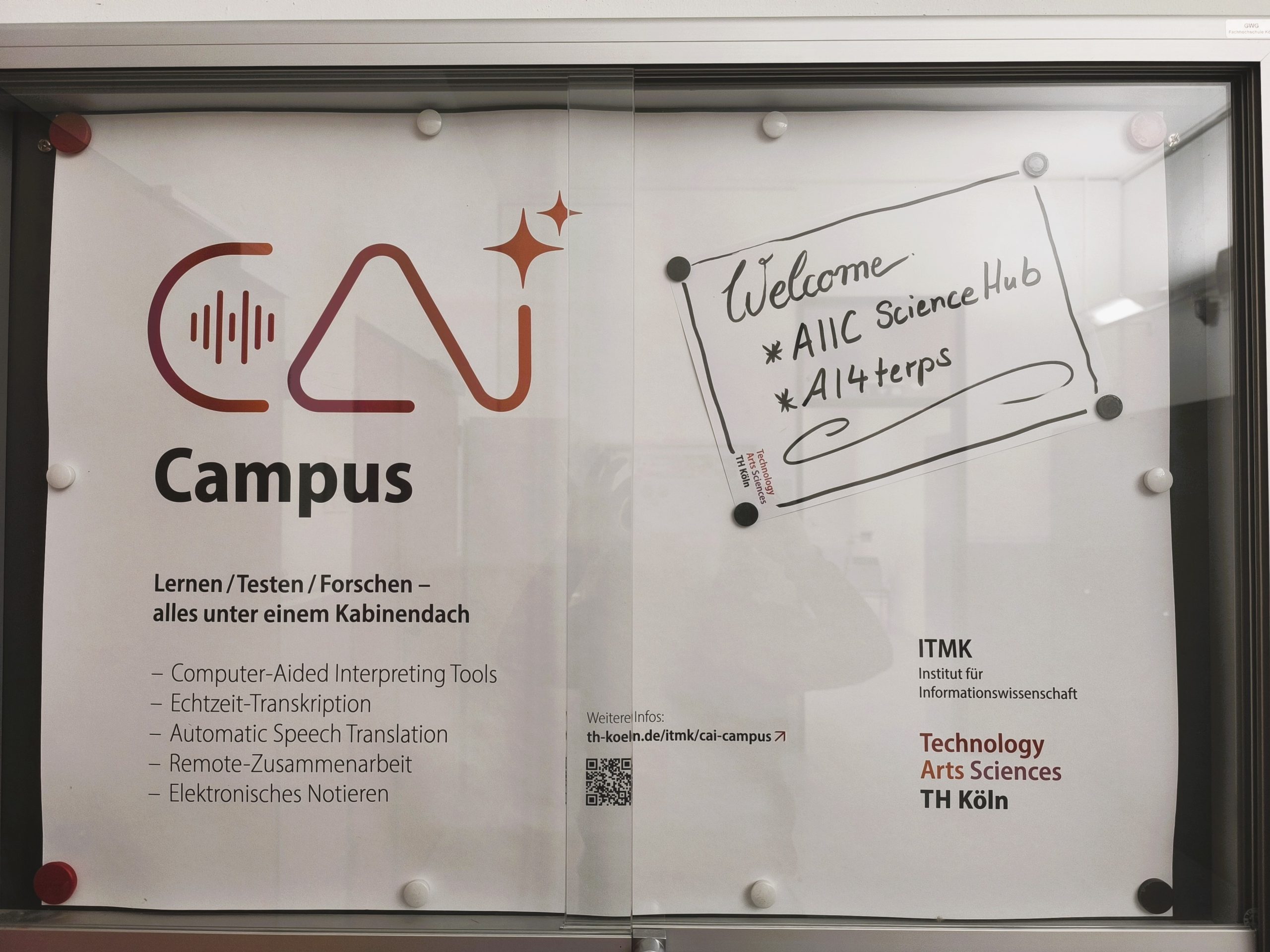
Last November, finally, we received our first group of CAI-crazy guests at Cologne’s CAI Campus. A fabulous team of eight AIIC Science Hub members met to spend three very intensive days at TH Köln to work with different CAI tools. It was the CAI Campus inaugurational pilot run, a tool test session, a professional workshop, and, as it happened, a fantastic food specialties exchange project – all at once. The event was orchestrated by the AI4terps team.


The AIIC test team
In the AI Workstream of AIIC’s Science Hub, our first year of activity was dedicated entirely to providing general orientation in the landscape of AI & interpreting, as well as guidance on the “Is Automatic Speech Translation worth a try?” discussion. That mission accomplished, we now wanted to embark on the exciting topic of Computer-Aided Interpreting, and to create guidance on the use of CAI tools. To gather hands-on experience in a realistic in-situ setting with our tools being readily installed, we decided to meet up in Cologne. We were joined by two members of the tech workstream, which broadened both our perspective and the language coverage. So this was our fabulous team: Irina Paramonova (Russian), Magdalena Lindner-Juhnke and myself for German (doubling as organisers), Daniele Fonseca (Portuguese), Nan Zhao (Chinese), OLIVIER PÉAN (French), Viviana Tipiani (Spanish) and Bahar Çotur (Turkish).

AI4terps

AI4terps.org is an EU co-financed project aimed at creating an online self-learning platform on all topics related to AI in interpreting, including the basics of AI, Computer-Aided Interpreting, and Automatic Speech Translation. The platform is bound to be ready in autumn 2026, so stay tuned!
The project is conducted by TH Köln (Cologne University of Applied Sciences). The core team in Cologne working on the platform includes Magdalena Lindner-Juhnke, Nele Kirstein, Julia Baum and myself (with the invaluable support from our four external advisors Bart Defrancq, Michelle Hof, Bianca Prandi, Karin Reithofer).
 The Cologne AI4terps Team decided to plan and conduct some CAI tool testing together with the AIIC Science Hub in order not only to create content for the platform and further research (75 GB worth of screen recording videos …). We also wanted to make sure we understood what users really need to know in order to grasp CAI, and be aware of potential hiccups in both training and use. After all, we want our users to be able to make informed decisions and get the most out of using such tools.
Activities
The tools we tested were Boothie, Cymo, InterpretBank, and TerpMate. Throughout the three testing days, we kept feeding our comments into a feedback table. We also kept a record of technical bugs and hiccups, but these were shared exclusively with the software providers, as we reckon most of them will be fixed soon.
On the first day, we spent some time familiarising ourselves with each tool. We then went into the booths and worked with the tools while different videos were being played on the big front screen. We had been collecting practice videos beforehand to make sure we had enough suitable material containing problem triggers such as numbers, accents, and technical terms. The main source language we used was English, as this was the language we could all work from into our respective A-languages. But we also played some videos in the other languages to see what the quality of the live transcripts was like.
On day 2 we looked into the different features in more detail, such as glossary upload, term and number recognition, transcripts, and live translation. We used the tools with different videos (although the notorious piece on bird flu from day 1 kept being replayed occasionally, just for the fun of it …). Meanwhile, Daniele and Nan also kept doing latency measurements. A feature matrix – which will also feature on AI4terps.org – was completed bit by bit.
General takeaways


Anja Rütten has specialised in tech, information and terminology management since the mid-1990s. She holds a professorship in interpreting studies and Computer-Aided Interpreting at the Cologne University of Applied Sciences.
Disclaimer:
Views or opinions expressed are solely my own and do not express the views or opinions of my employer.
Leave a Reply