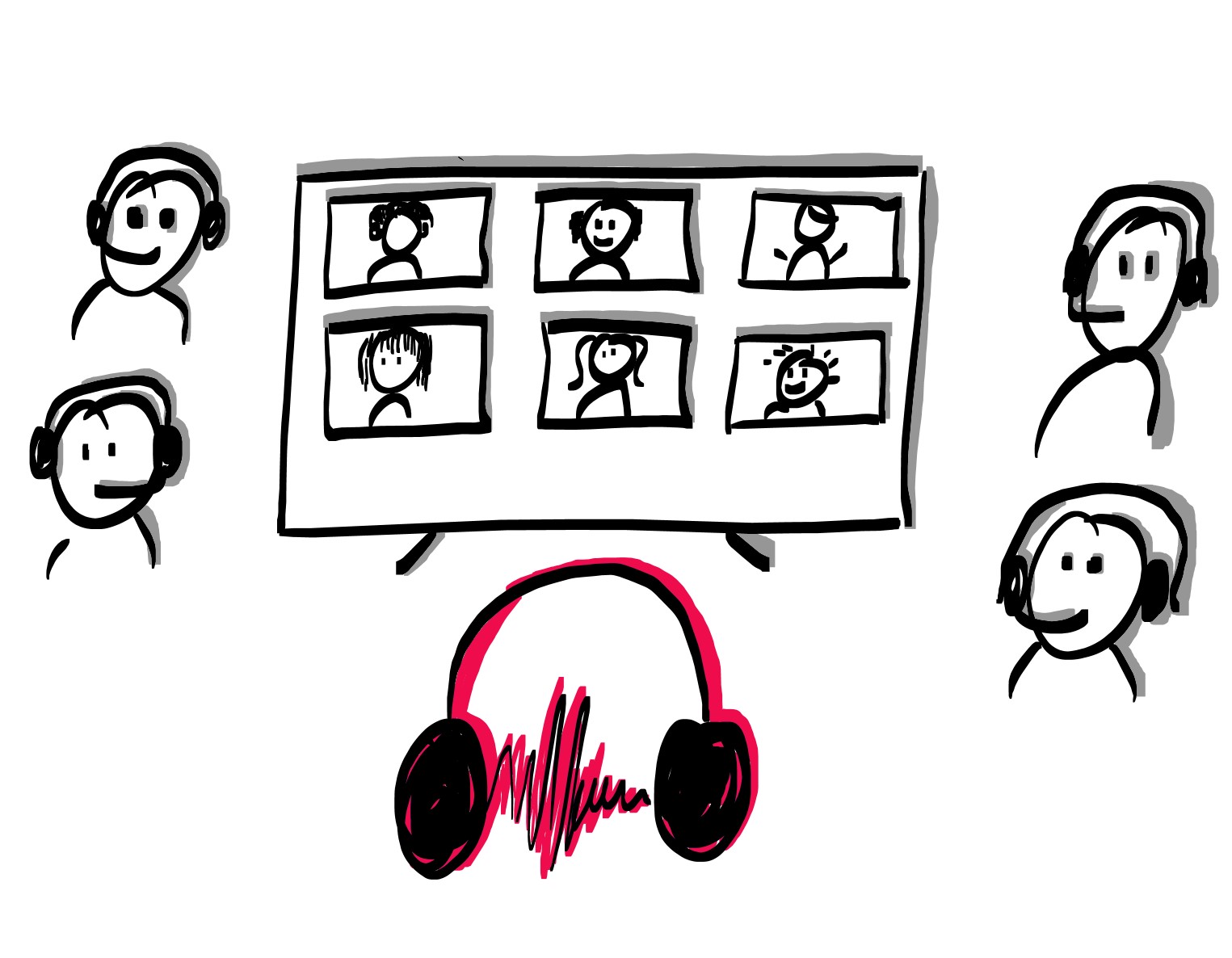
As I was looking for a subject for my master’s thesis, I read in many articles and books that remote simultaneous interpreting (RSI) is not very popular amongst interpreters. It comes with multiple difficulties: communication with a boothmate is harder, internet connections can be unstable, lack of social contact, health risks, etc.
To mitigate the negative consequences of RSI on interpreters, AIIC published Guidelines on Distance Interpreting, the first version in 2019 and the most recent one in 2025. The latter is the one I focussed on in my survey. I wanted to find out why RSI is still written about as something negative. Are the guidelines and recommendations not sufficient? Are they being applied in practice? To answer these questions, I created a questionnaire based on the AIIC 2025 guidelines.
76 interpreters participated and answered the questionnaire. The age groups were well distributed. About a quarter of participants fell into each of the following age groups: 31–40 years, 41–50 years, 51–60 years and over 60 years old.
The majority reported having a maximum of 40 RSI assignments a year. During RSI assignments, interpreters mostly work while being physically separated from their boothmate(s).
In the following, I will describe the main findings of the survey in relation to the AIIC guidelines:
Reducing the Duration of Working Sessions and Adequate Breaks and Working Hours
The vast majority of respondents have one interpreting session per RSI assignment (71.1%). These single sessions are mostly shorter than for in-person meetings and follows the recommendations. However, in cases where assignments are made up of two sessions, the total duration exceeds the recommended duration.
Strengthening the Interpreting Team
For this recommendation I used 4 settings listed in the AIIC’s Professional Standards: bilingual conference interpreted into 1 language, into both languages, into 3 languages, and into 4 languages.

The numbers indicated on the image show how many interpreters should be working depending on the number of languages in an in person conference. For RSI assignments, the number of interpreters should be higher.
This recommendation is followed more closely in certain settings than in others, particularly during bilingual conferences where interpreting is provided into both languages. For conferences interpreted into one language or into more than two, the teams are smaller than recommended. Most interpreters indicated that they never worked for bilingual conferences interpreted into 3 or 4 languages.

Taking additional measures to ensure sound quality and minimise exposure to potentially harmful audio
One possible measure is to test the equipment prior to the meeting. In the majority of cases, these tests are “always” or “frequently” carried out.

However, the tests don’t change the interpreters’ answers about audio quality: it is mostly rated just “average”.

Insufficient sound quality is mostly attributed to the clients’ technical setup: mediocre or no equipment (in particular microphones) and background noise were some of the factors mentioned.
One respondent wrote: “Participants use their own microphones, often of poor quality. Very often participants don’t use a mic at all!”
Another respondent said: “Participants frequently don’t use proper mics, despite this having been contractually agreed.”
Limiting Interpreting Shifts
This recommendation seems to be already part of interpreters’ routines. Most of them hand over to their colleague after 20 minutes (76.3%), 17.1% after 15 minutes.
Improving Team Communication
The most widely used tools are Whatsapp, Whereby and Google Meet, thanks to the video feature. However, some challenges remain: unstable connection, handover difficulties, and disagreements between colleagues about whether or not to use a booth communication channel and which kind of channel (video, audio, chat).
One respondent explains that there is also less communication due to the physical distance: “Sometimes they don’t write anything down for me, because we are more detached from each other, less in the moment together.”
Another respondent shares their negative experience with one colleague: “Once one colleague wouldn’t allow us to be in video communication, it was very hard on me, both performance wise and emotionally.”
Dedicated technical support
Results are mixed here. In most cases, this assistance is “sometimes” or “rarely” present. Clients do not (always) offer technical support due to budgetary constraints or because it is not seen as important.
The latter is proven by one respondent’s answer: “Because clients do not understand the importance of this request.”
Enhanced Technology and Visual Context
In most cases, interpreters judge the video quality as “good” or “average”. AIIC also recommends multiple camera angles, but in most cases, only one angle is offered. According to the results, interpreters don’t consider this important, as seeing the speaker’s face is enough.
Strengthened Communication with Organisers and Participants
This recommendation already seems to be well rooted in interpreting practice. Once again, when it’s not the case, it’s due to the clients’ lack of capacity, or because they ignore this recommendation and/or don’t consider it to be necessary.
Again, this fact is shown in one of the respondents’ answers: “Because it is necessary, hence we always request a separate channel for this, but, again, often ignored…”
In conclusion, some of AIIC’s recommendations have already become common practice for interpreters: It goes without saying that they have shorter work sessions, hand over to their boothmate more often, and maintain a communication channel between interpreters and organisers. However, deviations from each recommendation can also be observed, although not all of them are considered to be critical by respondents. Clearly, technical support and good sound quality are considered the most important points. The latter is undoubtedly the most crucial factor in ensuring that interpreters do not suffer damage to their hearing.
About the author – Mathilde Kuhn
Leave a Reply