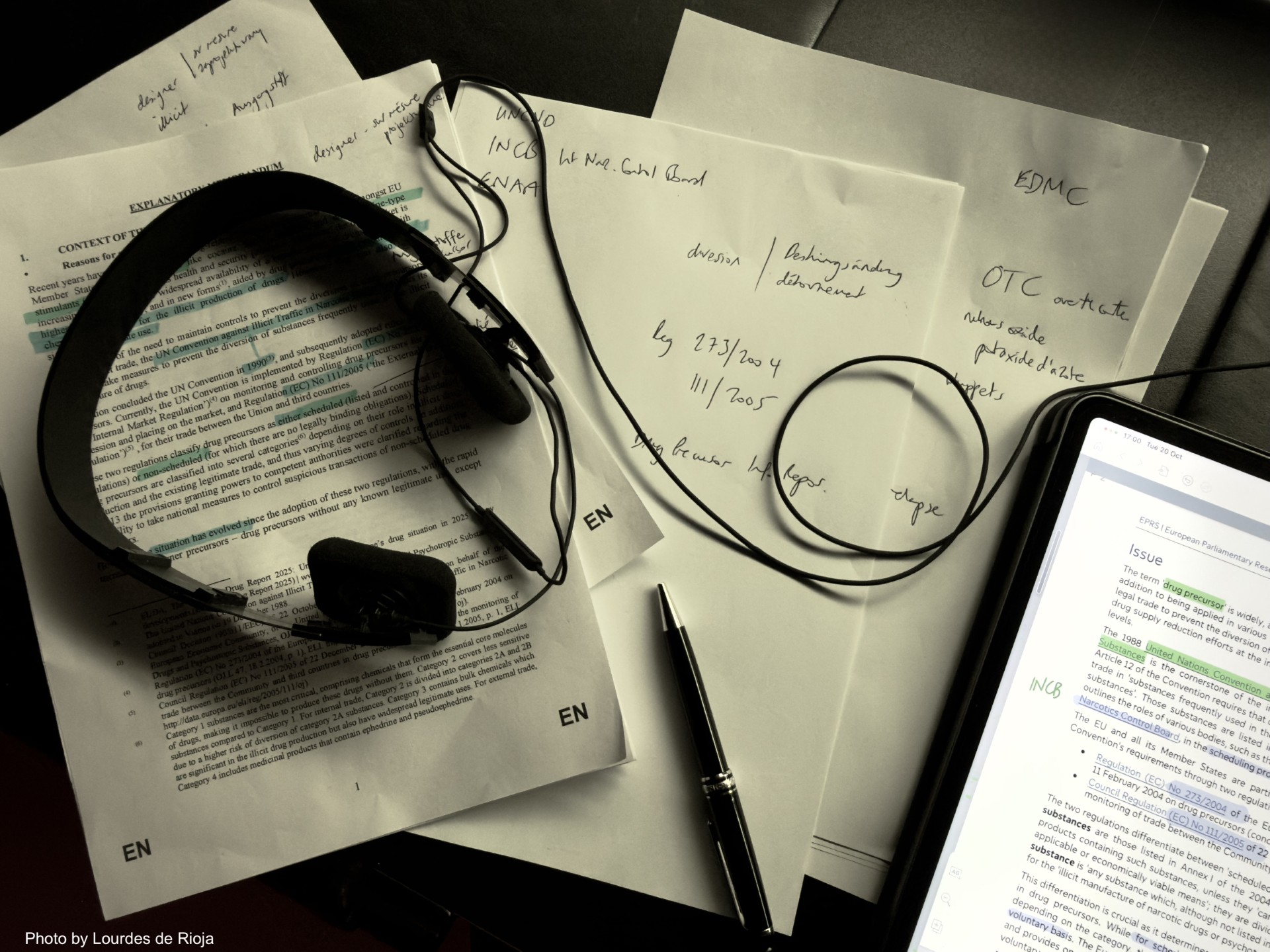
When the Chairperson says, “and that brings the meeting to a close” and turns off their microphone, interpreters will often gather up all the papers and hand-written notes on the work surface in front of them (be it real or digital), even carefully prepared word-lists and toss them into the nearest bin. This signals the end of the assignment in a very physical way and perhaps offers closure on some of the professional trauma of the day.
In this article, however, I’m going to suggest you resist that temptation and that you keep whatever papers and notes you’re allowed to keep just a little longer, so you can write up & organise the terminology, review your notes, and exploit the benefits that that process brings with it!
It should be no surprise that a strategy that involves a little more organisation and self-discipline than most comes to us from Germany. Martin Will and Sylvia Kalina have described this activity as “conference follow-up” and “post-process” respectively. Which brings us to another problem. Neither of these terms clearly bring to mind what the activity actually involves; neither trip off the tongue; and inconveniently neither function very well as verbs!
So what can we call it? *Post-paration? Oh damn, we don’t have that word in English. It’s more than “review”, not quite “check” and “*post-preparation” would be a linguistic tangle. Personally I thought it was called “writing up your notes” but that doesn’t cover the whole activity either. Perhaps the solution is not to translate. Maybe like Wanderlust, Zeitgeist and, of course, Schadenfreude we should just import the unimprovable German word – in this case Nachbereitung. Where Vorbereitung is preparation, Nachbereitung is, logically enough, what interpreters do with the meeting materials after the event.
To add literary insult to terminological injury, Nachbereitung has been almost entirely ignored by interpreting literature, despite the fact that a lot of interpreters do it. Don’t be fooled by the long bibliography below, all bar one of those texts devote no more than a line or two to Nachbereitung. Even my favourite, and the most comprehensive, book on Conference Interpreting ever written says only of material and terminology prepared before a conference… “afterwards save it for re-use” (Setton & Dawrant, p341).
What is Nachbereitung?
Nachbereitung is the act of reviewing one’s notes (and the information they contain), terminology, documents, and understanding of a recent interpreting assignment – be it from the preparation or in-meeting phases – and then completing and consolidating, before writing them up into a structured system for future reference. That could mean not only entering terminology into glossaries and databases but also creating information cheat sheets and addressing interpreting strategies.
An interpreter’s approach to terminology involves three stages according to Martin Will, one of the very few terminology experts in the world of interpreting, who I was lucky enough to work with many times early in my career.
1. Before the assignment: preparation and research.
2. During: Using and cross-checking terms terminology from the preparation phase. Conferring with your boothmate to check and tally terminology. Researching terms that occur live or appear in last-minute documents.
3. After: reviewing and completing both the terminology and (non-confidential) as well your conceptual understanding of what was said. Then adding those to structured terminology management systems.
If we add information (facts, figures, proper nouns etc.) to this equation we get Nachbereitung.
We’ll examine the advantages of follow-up in a moment. But first let’s have a look at…
Nachbereitung in detail
When a meeting ends we usually have some or all of the following in front of us – meeting documents with our own annotations; a multi-lingual word-list prepared before the meeting, possibly annotated during the meeting; several sheets of more or less organised hand-written notes taken by hand during the meeting. For more detail on what interpreters actually note down during a meeting check out this study by Anja Ruetten. What do we do with all that? For the purposes of this article I will split Nachbereitung into 4 activities but in real life some of these things will be done at the same time.
1. Review terminology
1.1 Review and compare terminology (and translations) from the preparation phase against that heard and noted down during the meeting. Check where different (usually giving more weight to what was heard in the meeting). You may decide to keep only the term actually used, or both in your glossaryW. If this meeting has its own technical jargon, that will be identifiable in the meta-data that says the terms came from this meeting.
1.2 Double check terminology heard for the first time during the meeting.
1.3 Add context information, meta-data and/or definitions, to the terminology.
1.4 Transfer the new terminology to a larger glossary or database for retrieval and use the next timeC you do the same, or a similar, meeting.
1.5 Check which terms from the preparation phase and existing glossary were required/used/searched for during assignmentW and possibly mark them as more or less useful in your database.
1.6 Check the existing glossary/database against new terminology, complementing and correcting as necessaryW.
For more on how to create a structured glossary see this page.
2. Organise terminology
2.1 Consolidate terminology. As soon as you do the same meeting or topic more than once, you can consolidate multiple wordlists into a single glossary or into a single category (a meta-data tag like “topic” or “client name”) within a broader database. This means that you can filter the whole database for the meta-data tag and find those terms and related ones quickly in future.W
Meta-data 1995 (left) versus meta-data 2026 (right)

2.2 Tweak the structure of the existing databaseRK in the light of the new terminology going in. Do you need to divide a meta-data category into sub-categories because you now have too many terms in a category?W Do you need to rethink demarcation of categories because new information doesn’t fit or shows categories to be poorly defined?S
Example: the glossary below category started out as “wind turbines” but after a couple of years I realised that in the work I do, the category was divided into at least three sub-categories that it wasn’t useful to see together – blade dynamics, electricity generation and materials science. So I went through and added those three as sub-categories to that meta-data column. Now I can filter for terms from any of the three sub-categories within the category of wind turbines.

If at the same time I also go across to my “aeronautics” and “gas turbines” categories I can also assign some terms there to the sub-category “blade dynamics”. This will create a broad cross-cutting category “blade dynamics” which can be filtered for without specifying “wind turbines” or “aeronautics”. That’s useful because the science and terminology of blade (aerofoil) dynamics are the same or very similar across multiple fields.
3. Information management
Slightly different to terminology management. If we were to try to draw a fuzzy line between terminology and information, it would be to say that “information” is those things that might not need to be translated but are useful to have prepared for a given topicR.
For example:
– names of participants (always very useful at the start of the next meeting!);
– job titles or the names of internal programs and departments;
– acronyms;
– benchmark numbersF and orders of magnitude;
– important dates, etc.
Because we don’t always translate these things, there is a tendency not to include them in a glossary. However, it is really useful background information for the meeting that you want to be able to retrieve for next time.
Information could be compiled in the form of independent cheat-sheets per meeting or topic, or combined in a specialised software tool (see KMTs below).
3.1 Add new information to, and consolidate the information base.
3.2 Update out-of-date information in the light of the assignment.
3.3 Review and check comprehension of substantive arguments (eg. does the thrust from a turbo-fan jet engine come from the fan or the jet exhaust?).
3.4 Review the structure/organisation of the information base in the light of the new information.
One possibly confusing point is that the software you will need for information management is generally called “knowledge management” tools (KMTs). Information management is slightly different to knowledge management but they often appear as a pair – information & knowledge management. But that’s a story for a different post!
There are now a whole range of KMTs available. As an example, the image below shows one such tool, Obsidian. On the left you can see its map view showing how each “notes” file is linked to other files. The map view you can see three nodes, directing radially to sub-sets of that topic, EP (European Parliament), Country Profiles & DRC Congo. The right-hand image shows a typical “notes” file.

For a more detailed description of how interpreters might go about their information & knowledge management see this article by Anja Ruetten (in German).
4. Interpreting strategy
Interpreting strategy can be also considered a specific sub-set of information management.
4.1 Analyse why parts of the assignment were more challenging. Note down the results and possible solutions for next time. A speaker may have a particular accent or regional variety of the language, they use complex syntaxS, or have a particular style. Equally the register of language spoken by this group may have certain characteristics that require a certain type of reformulation or interpreting strategy. An interpreter can prepare for all of these things ahead of the next assignment.
When to do your follow-up
Anecdotal evidence and an informal survey I carried out of 150 EU-accredited colleagues, with +/-50 responses, suggest that many interpreters intend to follow-up, but that it often doesn’t happen. Life often gets in the way of this sort of thing! So my suggestion is to do the follow-up as soon as possible, if not before leaving the booth. The longer you wait, the less likely it seems you will be to get around to it. Also the sooner you do it the fresher terminology and meeting content will be in your mind. That will make the write-up easier and more useful.
How long should you spend on this? That will depend on the meeting and the topic. Often it takes no more than 5 or 10 minutes because the information and terminology is already in your system. Sometimes it might take longer – for example if you decide to re-organise glossary categories or get dragged down some internet rabbit hole – but it’s very much your choice!

The advantages of Nachbereitung

B. Improved LT memory retention of terminology. From the ancient Greeks (“repetition is the mother of all learning”) all the way to interpreting’s very own Daniel Gile (and his gravitational model of language acquisition) everyone will tell you that revisiting terminology is essential for committing it to our long-term language repertoire (passive or active).
C. Consolidation of information in organised categories in a glossary/KMT makes terminology and background information easier and quicker to find and use next time, be it during preparation or actually in the booth.
D. Reviewing information leads to a better understanding of the concepts discussed and points of view expressed. This is a standard recommendation to students following lecture courses and it applies to interpreters and their meetings as well. Information reviewed will be useful as general knowledge and specifically for the next edition of this meeting.
E. Quality assurance 1 – catch errors and/or inconsistencies in prepared terminology or information or in your existing database(s) while it is still fresh in your mind.
F. Quality assurance 2 – we’ll use terminology more consistently because it has been recorded and reviewed.W
G. By reviewing performance we may come up with improved interpreting solutions. That includes not just better translations of terminology but also how to deal with a particular speaker’s syntax or style or a group of speakers’ register. That will serve us in the future.
H. Regular data entry and use of your database create familiarity with them, so it’s easier to understand if the organisation of your database corresponds to your needs and therefore (re-)organise glossaries/databases as they grow and/or as your needs or clients change. And they will!
I. Anyone with any degree of OCD tendencies will love all the organising and tidying! 😉
One important point we can see from this list is that the process of doing your Nachbereitung is at least as beneficial as the product of the Nachbereitung!
Many of these follow-up tasks could be done by AI nowadays but for a discussion of the advantages of doing it yourself, rather than letting an AI do it please see my Heidelberg lecture “AI or DIY” .
Collective Nachbereitung
Intuition, research, and practice suggest that while that different personal approaches and preferences are a barrier to collective terminology and information management, there is enough overlap to make it work R. Evidence of this can be found in the following attempts at collective Nachbereitung.
– The EU Commission’s interpreting service (SCIC) runs a joint blog for some meetings, so that interpreters can note terminology or key points of discussion for the next interpreters assigned to that meeting to consult.
– At the European Parliament, a small team of interpreters creates cheat sheets, under the heading Enhanced Meeting Preparation, which contain the key terms and background information on the very specific topics to be discussed in each Committee.
– At the European Parliament two French booth interpreters produce an explanatory podcast highlighting notable turns of phrase in French heard during the plenary session. Given the repetitive nature of political discourse this is useful for other interpreters ahead of the next plenary session.
– The Dolmetscher wissen alles blog has written about collective preparation in two articles Shared glossaries and Team Glossaries. Implicitly, the advantages mentioned, like time-saving, will apply also to collective Nachbereitung.
NB. All of these are no more than technological adaptations of the time-honoured method of asking your colleagueG what they can tell you about a given meeting.
Conclusion
The next time you complete an assignment, pause for a moment before you hit delete or throw your papers into the nearest bin and instead spend 10 minutes writing up your notes. It will be worth it in the long run!
_________________________
Glossary
category – non-technical word for meta-data. For example in a multi-topic database all terms related to agriculture will have the word “agriculture” in the “category” column so they can be filtered out of the whole database when required.
database – multilingual wordlist on more than one topic which uses meta-data to allow for filtering by topic/category, meeting etc.
glossary – multilingual wordlist on a single topic or from a single meeting
information management – half of the pair “information & knowledge management”. information management – half of the pair “information & knowledge management”. The organisation of new information like facts, figures and concepts. Usually includes terminology but the two are split for the purposes of this article.
knowledge management – half of the pair “information & knowledge management”. The interplay between (written) information and your memory
KMT knowledge management tool – software for compiling and creating interconnections between information notes eg. Obsidian. Not glossary software.
meta-data – technical word for category in a data-base, called “tags” in some software. For example in a multi-topic database all the terms related to agriculture will have the word “agriculture” in the topic column so they can be filtered out of the whole database when required.
__________________________
References
W = from Martin Will
S = Stoll
R = Rütten
K = Kalina
C = Conway
F = Fritella
__________________________
Bibliography and recommended further reading
In bold are the titles that devote more than a couple of lines to Follow-up.
Conway, E., Der Computer in der Dolmetschkabine
“Idealerweise sollten SimultandolmetscherInnen nach Abschluss eines Dolmetscheinsatzes
die dazu bearbeiteten Unterlagen, erstellten Glossare und andere relevante Informationen
so weit nachbearbeiten, dass sie zu einem späteren Zeitpunkt schnell auffindbar und
übersichtlich strukturiert sind” p37
Fritella, F.M., Preparing on numbers
Gatjens, Kuz & Osterberg, Handbuch Dolmetschen
Gillies, A., How to Build a Glossary
Gillies, A., Note-taking in simultaneous
Gillies, A., AI or DIY – a pragmatic approach to glossary building
Gillies, A., Consecutive Interpreting – a short course, p202
Rodríguez, N. et Schnell, B., Regard sur la terminologie adaptée à l’interprétation
(L’Actualité langagière, volume 6, numéro 1, 2009, page 21
Kalina, S., “Quality Assurance for Interpreting Processes”, Meta : journal des traducteurs / Meta: Translators’ Journal, vol. 50, n° 2, 2005, p. 768-784.
Kalina, S., Strategische Prozesse beim Dolmetschen“ (1998)
Newcastle University Note-taking in Lectures
Rodríguez N., & Schnell B., A look at terminology adapted to the requirements of interpretation
(Language Update, Volume 6, Number 1, 2009, page 21)
“the usual terminology methodology should be abandoned if the intention is to provide interpreters with specific glossaries tailored to their needs”
Ruetten, A., How to keep your glossaries as tidy as your kitchen drawer.
Ruetten, A., Proceedings of the 40th Conference Translating and the Computer, London, UK, November 15-16, 2018, p 132-144.
“99.6% [of terminological notes] were technical or specialised terminology”
Ruetten, A., What do conference interpreters’ booth notes tell us about their information management?
Ruetten, A., Team Glossaries
Ruetten, A., Shared glossaries in Google Docs
Ruetten, A., Wissensmanagement im Konferenzdolmetschen – ein bisschen Theorie
Stoll, C., Jenseits simutanfaehiger Terminologiesysteme
Toronto University, Reviewing After a Lecture | Learning Strategies,
Wieser, Terminologieverwaltungsprogramme für Dolmetscher
Will, M., Dolmetschorientierte Terminologiearbeit. Modell und Methode
Will, M.,Computer Aided Interpreting (CAI) for Conference Interpreters. Concepts, Content and Prospects
About the author:
Andy Gillies is a professional interpreter and interpreter trainer based in Paris. He interprets from French, German and Polish into English at the European Parliament, the European Patent Office, the European Space Agency amongst other places and enjoys preparing for assignments and tinkering with his terminology database.
Andy has published a number of articles about preparation and glossary building – some of which are included in the bibliography. Others can be found at https://andrewgillies.eu/publications/
Leave a Reply