Is “machine interpreting” interpreting? I don’t think so.
Can we call it machine interpreting? Well, there are certainly reasons why we can, and other reasons why we shouldn’t.
So why can we?
Firstly, I think we are fighting a loosing battle. Machine interpreting, AI interpreting and other similar terms are already being widely used in the public debate. I think it is very optimistic, to say the least, to think that we will be getting anywhere by using a clumsy term that no one outside our conference interpreting bubble will make sense of.
Also, there are other things that are mimicked by machines and still named according to the original human activity. Just think of „machine abstracting“, „machine translation“, or “chatting”. It is common practice to name such machine-based processes after the human cognitive processes that inspired them, although they obviously are not really doing what they pretend to do.
On the other hand, it is definitely problematic that people might not understand that such machine-based processes do not involve the same depth of semantic and pragmatic understanding. And it becomes even more problematic for terms that make explicit reference to the very thing that computers, or AI in particular, do not: “interpreting” is exactly what human intelligence does and artificial intelligence does not. Consciously deciding on a target language version based on an interpretation of what the speaker wants to say, taking responsibilty and making communication happen is what the original, human act of “interpreting” between two languages implies.
But then, what are the alternatives? In principle I am all for using naming conventions to convey a message, raise awareness or simply be correct. However, in this case, being correct isn’t as straightforward as calling „the thing“ live translation or automatic speech translation.
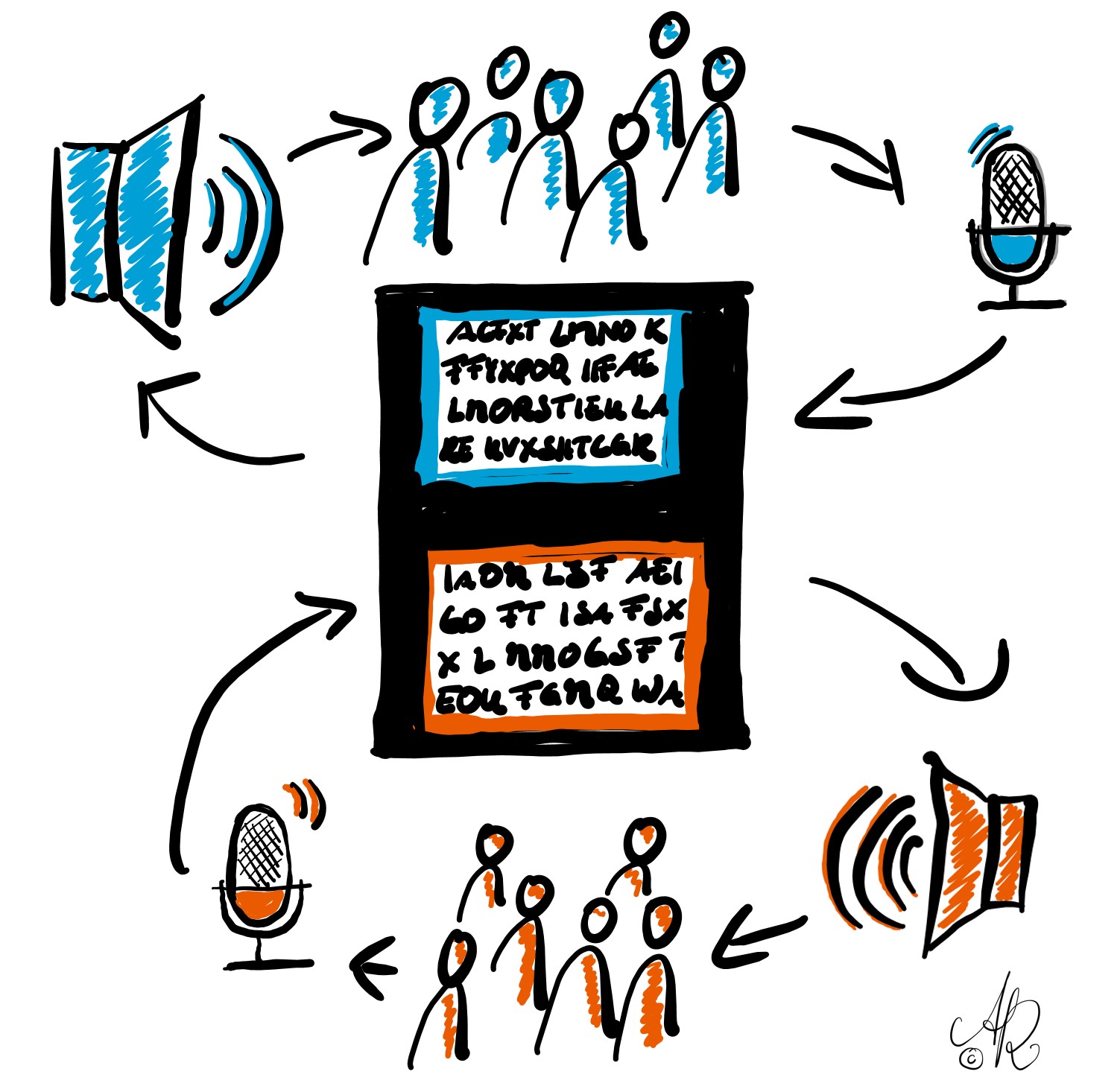
Using the term (live/speech-to-speech) “translation” may be justified to refer to the cascading or three step process currently in use predominantly, i.e. speech-to-text > machine translation > text-to-speech. But once end-to-end models become the mainstream approach, this won’t apply anymore.
And then, if we want to make the point of machines or AI not understanding the meaning and context of a message, „translation“ is not the right term in the first place. I don’t think anyone would argue that translators do not look at the meaning and context of the words they are translating, even if their activity is not named accordingly.
Even the European Commission says: „Interpretation is often confused with translation. The difference is that interpreters work with the spoken word whilst translators deal with written texts.“ No reference is being made to interpreters understanding more deeply than translators.
The ISO 23155 definitions of interpreting and translating don’t distinguish between the intricacies of cognitive processing either:
3.2.4 interpret: render spoken or signed information from a source language (3.1.4) to a target language (3.1.5) in oral or signed form, conveying both the meaning and language register (3.1.10) of the source language content (3.1.15)
3.2.5 translate: render source language content (3.1.15) into target language content (3.1.16) in written form or signed language (3.1.3)
And finally, after decades of trying to make it clear to clients/friends and family/the world that translation and interpreting are not the same thing, it would be rather counterproductive to start mixing up the two terms again.

A more appropriate term to describe the machine-based process could be “transcoding” or „transcodage”. It refers to the conversion of one code – in the sense of a system of signs – into another. In interpreting studies it is used to describe an emergency strategy consisting in word-by-word processing relying on the surface structure, potentially without understanding the underlying content or intention.
As to the oral character of the process, it might be a good idea to make this more explicit. Saying „speech-to-speech“ helps to specify the mode of delivery. Possible variations can be speech-to-text (live subtitling), text-to-speech (sight translation), and also text-to-text live translation.
Simultaneity is another characterising feature that needs to be made very clear. When reference is made to “AI interpreting”, very often apples are being compared to pears. Uploading a video or audio file and downloading it in a different language several minutes or hours later (dubbing) just isn’t the same as having it rendered simultaneously/live/in real time. Transferring the message of a text with a latency of very few seconds, i.e. without knowing the rest of the text (or sentence), is an altogether different process from rendering the text as a whole.
With regards to „live“ as opposed to „real time“, I think both expressions could be argued for. I have a slight preference for „live“. It implies, just like „live music“, that it is immediate and that there is no post-editing, and that living beings are involved (for the moment, at least the speakers are living beings). „Real time“ for me has a more technical ring to it, like in „real time computing“, which is often even calculated in terms of milliseconds. It might, on the other hand, be more reflective of the fact that a machine and not a human is doing the job.
Thus, if we want to do this properly, machine interpreting needs to be called something like
Live speech-to-speech machine transcoding – LS2SMT
So, what’s the right term to be used?
I don’t think there is a clear “right or wrong” answer. Maybe different terms need to be use in different contexts (business vs. academic vs. public debate)? For the time being, I am rather inclined to take a pragmatic approach and call “the thing” machine interpreting.
About the author:
Anja Rütten has specialised in tech, information and terminology management since the mid-1990s. She holds a professorship in interpreting studies and Computer-Aided Interpreting at the Cologne University of Applied Sciences.
Disclaimer:
Views or opinions expressed are solely my own and do not express the views or opinions of my employer.
Further reading:
Is machine interpreting interpreting by Franz Pöchhacker
The Strategic Dimension of Interpreting by Kurt Kohn and Sylvia Kalina
What’s conference interpreting after all? blog article by Anja Rütten
Leave a Reply